
A person’s health is defined by a variety of factors, beyond their physical activity and eating habits – so, addressing a complex and chronic disease such as obesity requires an individualised, personalised approach that understands how each of these factors, including genetics, surrounding environments, and socioeconomic status, can be considered when introducing approaches to address obesity.
But, with nearly half of people in Europe overweight or living with obesity [1], how is it possible to deliver personalised interventions? The BETTER4U project aims to undertake this challenge by using artificial intelligence (AI) to support the decision-making process and interventions that health practitioners use to support their patients.
As a central component in the BETTER4U project, AI is being used to help deliver personalised recommendations on how to improve their health outcomes, aimed at specifically supporting people living with obesity. As the use of AI becomes more widespread, it’s crucial that ethical use applies – where individuals’ health is concerned, ethical use of AI is non-negotiable. So, in a research project that is built on an AI model, how can we be sure that AI is being applied fairly? With the University of Vienna (UNIVIE) specialising in AI ethics, their work in the BETTER4U project is to ensure this is not only an aim, but an action.
We spoke with Olga Startseva, researcher at UNIVIE and leading the Ethics, Legal and Regulatory Compliance components of the BETTER4U project, to unravel the purpose and outcomes of the recent health AI Fairness internal workshop, aimed to support the work of BETTER4U researchers.
- The UNIVIE team comprises Olga Startseva, Rodessa May Marquez, and Professor of IT and IP Law Nikolaus Forgó, Head of the Department of Innovation and Digitalisation in Law. Together, their role is to ensure that the development of BETTER4U’s AI system meets the highest ethical and legal standards, including requirements around fairness, transparency, and accountability.
In brief: What is meant by ‘AI fairness’?
AI fairness means that an AI system does not produce outcomes that are systematically more precise for some groups of people than for others.
A model may look accurate overall while performing less accurately for specific groups, for example, older users, people from lower socioeconomic backgrounds, or those from underrepresented populations. Fairness requires that we actively examine whether this is the case and how we can address it.
AI fairness is not just a technical question, it is also an ethical and legal one, rooted in the principle that no one should be disadvantaged by factors outside their control.
Training the BETTER4U team on AI fairness
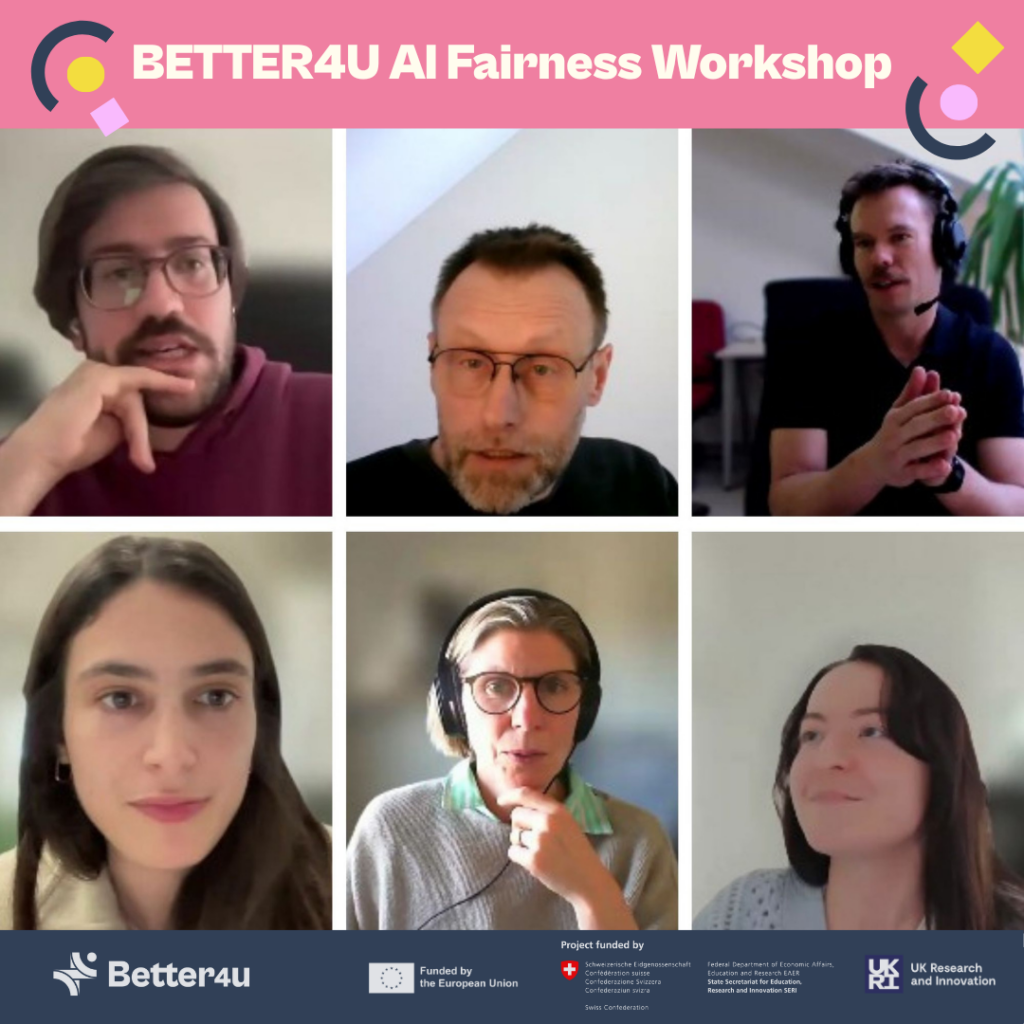
The workshop was interdisciplinary in design, bringing together researchers, clinicians, data scientists, and other experts from across the many aims of BETTER4U. This diversity was deliberate: fairness in AI cannot be assessed by experts from one discipline. It requires clinical knowledge, technical expertise, and ethical reflection working together.
The purpose of the workshop was to create a structured space for the consortium to examine BETTER4U’s AI model from a fairness perspective. As a new developing field, UNIVIE drew on existing AI fairness literature and available guidelines, including the Alan Turing Institute’s guide on AI Fairness in Practice.
During the online workshop, participants worked in four groups, each examining a different stage of the AI development process in BETTER4U and a different fairness dimension:
- training and validation data,
- model design and development,
- model testing and validation,
- evaluation metrics.
For each stage, the groups discussed what fairness concerns had been identified, who could be harmed if those concerns are not addressed, and what should be done about them.
What’s the outcome of the workshop?
The workshop will produce two concrete outputs:
- a Bias Self-Assessment, which is a formal record of the fairness risks identified, and the mitigation measures proposed and already implemented,
- a Fairness Position Statement, which sets out BETTER4U’s commitments on how we measure AI fairness in the BETTER4U consortium.
Beyond the documents themselves, we hope the workshop has built a shared understanding across the consortium of what fairness means in the context of BETTER4U, and why it matters.
Who may be harmed if fairness is not considered?
Health outcomes and, therefore, AI predictions may differ systematically across groups of people having different identities based on sex and gender, age, disability, geographic location, sociodemographic status, and migrant or ethnic background. These are the groups for whom AI health prediction models in general may perform less reliably without anyone realising it, because overall AI model performance does not consider the differences between groups or individuals. This may happen because of a lack of representation of certain groups in training and validation data (for instance, data from clinical trials tend to include young, educated males, who are the most likely to participate in clinical trials) or poor quality of the training data (as inconsistencies are common in health records from hospitals).
In a health context, this matters enormously. A recommendation that is appropriate for the “average” user but wrong for a specific group or individual makes the model, at best, useless for these groups or individuals.
How is fairness measured?
There are two main approaches:
- Group fairness asks whether the model performs equally well across defined groups of users, for example, whether predictions are equally accurate for males and females.
- Individual fairness asks whether two users with similar profiles receive similar predictions regardless of their protected characteristics.
Different mathematical metrics operationalise these approaches, including demographic parity, equalised odds, and true positive rate parity. Crucially, these metrics involve trade-offs: you cannot fully satisfy all of them simultaneously. Choosing which metric to prioritise is not a purely technical decision; it is a values decision that the whole team needs to make consciously and document transparently.
In BETTER4U, we define fairness in our system as individual fairness, since we provide personalised health recommendations to the users. We chose this based on the observation of the databases and algorithms chosen.
Why is it important to consider fairness when conducting research via AI?
AI systems in health do not operate in a vacuum. They inherit the inequalities present in the data they are trained on, and they can amplify those inequalities if their design is not carefully examined. The EU Ethics Guidelines for Trustworthy AI identify fairness as one of seven key requirements for AI systems, alongside transparency, accountability, and human oversight.
- The EU AI Act, which came into force in 2024, requires that the health prediction tools, which are likely to be classified as high-risk AI systems, are trained, validated and tested on the datasets examined in view of possible biases that are likely to affect the health and safety of persons, harm fundamental rights or lead to discrimination prohibited under EU law. The AI Act requires providers of such systems to implement measures to detect, prevent and mitigate possible biases. These measures help to ensure that AI systems for healthcare do not perpetuate existing biases, but instead promote better access to healthcare for all.
Why does this kind of structured fairness reflection matter for a health AI project like BETTER4U?
BETTER4U is designed to support people in managing their weight and improving their health. But the populations most likely to struggle with obesity-related health issues are often the same populations least represented in health datasets, such as people from lower socioeconomic backgrounds, older adults, and people living in rural areas. If the model has not been built and tested with these groups in mind, it risks being most reliable for the people who need it least, and least reliable for those who need it most. Structured fairness reflection, involving bringing the whole team together to examine the model during its development, ideally at each stage, is how developers can identify and address these problems before deployment.
What are the next steps?
The outputs from this workshop will be circulated to all consortium partners for review. Workshop participants themselves requested a follow-up session at a later stage of the project, once the AI model’s predictions and healthcare specialists’ feedback on its development are available for discussion. We expect the follow-up to focus on model explainability and the experience of clinical users working with the model during the research process.
With demand from the BETTER4U consortium for a follow-up session, this suggests that fairness in BETTER4U is a shared commitment and that these sessions are helping to build a concrete strategy for achieving this aim across the project.
[1] According to Eurostat, in Europe 50.6% of people >16 years old were overweight in 2022. Source : https://ec.europa.eu/eurostat/statistics-explained/index.php?%20title=Overweight_and_obesity_-_BMI_statistics